

BACKGROUND:
Over the many years in the electronics game I have obtained, played with and sometimes used some of the strangest components or systems. These range from Gamma Radiation detectors (used just after WWII by personnel to check for ambient radiation levels) , Bio technology hardware used to research Nano technology in the laboratory, test equipment to measure and display graphically the magnetic properties across an entire floppy disk surface, used by floppy disc manufacturers for QC and then there is this little display - an oddity of the 1970's era.
Way back 'in the day' when Nixie tubes ruled the world and were subsequently superseded by LED and LCD 7 segment displays, there were these incandescent displays ... not semiconductor based at all but all of the segments are in fact tiny filaments, just like the old filament light bulbs that everyone used before changing to fluorescent or LED based lighting.
Imagine how difficult it must have been to manufacture these critters ... tiny little filaments inside a tiny little package and yet they had to be reliable, long lasting and easy to read even in full sunlight. These were not just 'a curio' but in common use across industries that demanded these sort of characteristics, industries such as the Aviation industry, Radar systems, petrol bowsers and even some industrial test equipment!
Those tiny filaments all had to be bright, of consistent intensity between segments and yet not generate masses of heat AND the whole display was designed to be driven by a 5V supply, making it suitable to interface with those "modern" TTL chips of the day.
Here is the display from the device I am offering ... "alive and kicking!" (It's a 7 segment display, Jim, but not as we know it!)
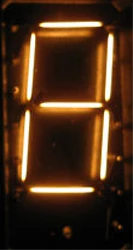
The most obvious feature of this type of display is the narrow, sharply focused segments which look quite unlike the more diffused light from a LED 7 segment display
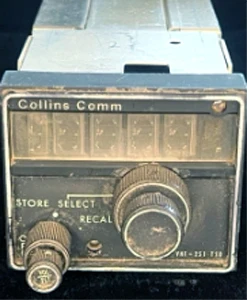
In the Avionics industry, these displays were commonly used in ARC, Narco, and Collins communications equipment. Here is a Collins receiver with five of these displays fitted
Two primary manufacturers existed, Toyo and Fujitsu and in general terms they were referred to as Minitron's, being the trade name.
So let's get down to the nuts & bolts of what I am offering ...
TOYO (Minitron) - 7 Segment Display (plus decimal)
Made in Japan
Circa 1970's
Often referred to as Numitron's although these are more often in glass envelopes and appear like a Nixie tube - these Numitron's are NOT Nixie tubes.
Part # KW-515F-4F
Basic specifications for these displays ...
- Sunlight readable
- Incandescent Display
- Wide viewing angle
- Sealed and impervious to salt and humidity
- Long life
- Compact design
- Even brightness at rated and dimming voltages
- Shock and vibration resilient
- Easily filtered for night vision compatibility
DIMENSIONS:
22mm (0.87") X 11.5mm (0.45") X 9mm (0.36") Height
Numeral height: 9mm (0.36")
Typical operating voltage: 5V DC
Typical current per segment: 8mA
Package is a 'standard' 16 pin DIL BUT the casing is metal, not plastics
Ok, so you have this dicky little 7 segment display and want to "turn it on" ... for fun
The following information will help you out.
Pin 1 is indicated by an Orange dot on the package
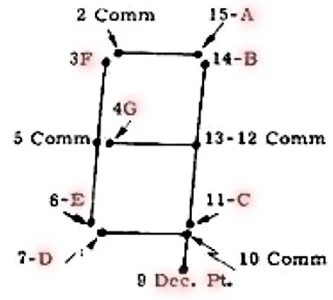
Note the multitude of "commons" on the device, this made testing (described further down) a laborious task with mini test leads everywhere!
The pinout diagram above was not created by myself and wanted to confirm it's accuracy so I sat down and carefully checked the segment connections and then "fired" them all up ... I can absolutely confirm the pinout broadly agrees with the diagram above, except there is NO pin 13 fitted (it has not broken off - it was never there!)
1 N/C
2 A segment
3 F segment
4 G segment
5 common to 3,6
6 E segment
7 D segment
8 N/C
9 Decimal
10 Common to 7, 9
11 C segment
12 common to 11, 14, 4
13 NOT PRESENT
14 B segment
15 Common
16 N/C
TESTING:
Geez, this display has been sitting in the "interesting curio's" drawers for a long, long time so with bated breath (drum roll ...) I put it to the test.
After 50 odd years, the leads had a bit of oxidisation on them so I cleaned them up first ...
Each segment measures 85 Ohm DC resistance
I powered up each individual segment and the decimal point - all segments (and the decimal) are working fine - impressive for an incandescent based technology that is so 'dated'.
Next, I fired up ALL segments at the same time (along with the decimal) to observe the overall evenness of light intensity - just amazing once again with no segment being any brighter (or duller) than another.
I did not set up a test gig driving it via TTL as I had already spent quite a bit of time working out the pin arrangements, segments etc but I have no doubt it would readily 'talk' to a counter or similar with TTL level outputs.
I have now put this unique display to "bed" on a piece of styrofoam and then packed within a sealed clear plastic packet - it now waits to either be put to use once again (me thinks ... "this is unlikely") or as a special piece of "electronic or avionics history" for the museum display!