

BACKGROUND:
You may be thinking "Russ is at it again ...WTF?" about this item ... to many these may just be a couple of old speaker connectors but I don't view old equipment that way because I am "really big" on reusing or repurposing old electronic components and hardware, particularly from the point of view of sustainability and I know others think likewise. If you see some old "useless" piece of equipment, try to view it as a "component farm" and visualise what treasures it may hold and these components could be cultivated for reuse.
Sustainability far more than NOT burying waste material back into the earth but consciously recognising the energy expended to create the item through it's various "stages" in life, beginning with the raw materials being extracted from the earth, processed, finished and then fitted into equipment - every single step used energy which is referred to as embodied energy.
To give an approximate representation of how much energy was used in the WHOLE production process of an item, I have created what I refer to as the Ee (Embodied Energy) value, measured in Mj
The Ee value is an approximation only and usually measured in Mj.
Coming up with an Ee value is an attempt to take into account the energy used for extracting and processing of the raw materials, manufacturing of the component, distribution of the component(s) and final assembly of the component. In fact the measurement of Ee can become extremely complicated and technical, many tertiary institutions are involved in this specialised field of science.
I have used various reliable sources online to arrive at approximate Ee values, these are approximations and the sole purpose is to raise awareness of the extraordinary energy consumed in the creation of various electronic components and hardware - it may give you cause to think twice before wasting all that energy and burying it in the ground, with the possible side-effects of poisoning the environment due to leeching.
HERE is a page I have created which gives some tables and more detailed information about specific Ee values for different materials plus a link which you can use as a starting point to investigate Ee for yourself.
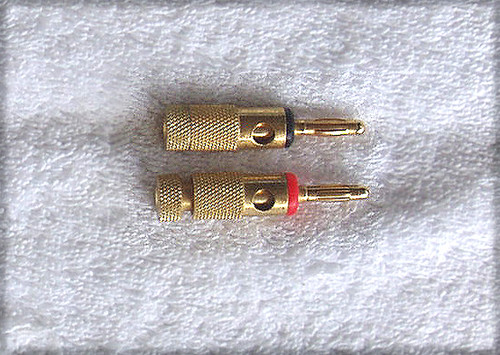
This offering is a set of two loudspeaker terminals (although they could be pressed into service as "general terminals" e.g for a power supply output), originally from some vintage English manufactured loudspeaker cabinets.
UNBRANDED - Terminal Post (Set of two)
Country of origin is unknown (although the loudspeaker system was UK manufactured)
Circa 1960's
Set of Red (1) + Black (1)
Solid diecast metal (ferrous) body which appears to have been plated (Chrome or Nickel?) Definitely some Iron in there as it behaves as a ferrous material (attracted by a magnet)
Coloured plastic front "activation" button which is used to depress the terminal top section and allow access to the hole for thru wire connections
Strong, positive spring action
Hole for the wires measures 4mm diameter
Base area is shaped so that it fits a hole and stays locked in position, secured by a metal bolt
NOTE that this terminal is not isolated from the mounting, you need to use an insulating strip or similar to mount these - originally they were are the rear of some loudspeakers, mounted on a phenolic board.
DIMENSIONS:
BODY
Top section 12.8mm diameter
Lower section 10.8mm diameter
The above section(s) slide over the base section, under pressure from the compression spring inside
Base section 9.9mm with two flat sides
Threaded hole in the centre, underside of the base
COSMETIC CONDITION:
USED
Clean
Spring compression is great, you need to push quite firmly to open up the hole and once the spring is released, the grip is tight!
Now packed into a sealed clear plastic packet, ready to be put to use once again ...