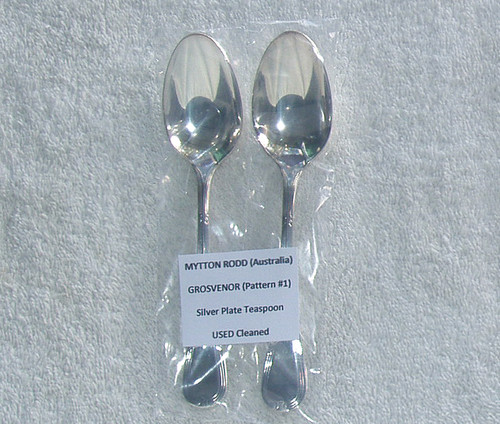


BACKGROUND ... What I know and also do not know ... (for sure)
The heritage of at least three of these knives began with "Rodd", this was an Australian company specialising in the craft of the silversmith. The company built up a long, distinguished reputation with particular emphasis on the production of finely crafted Silverware, Silver plate and hybrid Silver plate/Stainless Steel wares in later years. Not just cutlery either, in their early days, Rodd was very well known for some of the brooch designs they produced.
Over the years the company structure changed and their primary 'Grosvenor' period began in the 1960's with the new company structure of Mytton Rodd (Australia). By this time, Grosvenor was very well known for their Silverware 'canteens' (wooden cases with complete cutlery sets) which were often received as wedding presents by couples.
We do not usually offer items on other people's behalf, but an extended family member has acquired quite a bit of sterling Silver and plate. Knowing that our family runs a website where we are finding new homes for the masses of things we have collected over many many years, these extended family have asked if 'someone' may like to find new, appreciative homes for these items. Most are quite "ordinary", some a little strange and yet others are steeped in mystery - these knives are the latter ... obviously they are knives but even after considerable research, we can only take some "educated guesses" about where these came from.
If these knives already hold no interest for you, it may still be worthwhile to click HERE to take a gander at the other Grosvenor Silver plated flatware that we have had or are still available.
MYTTON RODD (Australia) - 8.5" Dinner Knives (6 in total)
Trade Name: GROSVENOR
Circa 1960's
Materials: Stainless Steel blade // Silver plated handle
There are actually NO EPNS, NS or even A or A1 stampings at all on the knife handles but I am 100% positive they are Silver based (plated) due to the way they reacted when being cleaned (LOTS of Black gunk came off them when in solution) I have dealt with Brittania metal previously (no Silver content at all) and these are definitely not BM material.
There are two distinctly different types of knives here ... the design or pattern is identical on all knives however three have a plain edged blade and the remaining three have a tooth (or serrated) bade edge - you can select which type of blade you prefer by using the checkbox on this page. It is important to READ everything in this description because, although the patterns are identical, I have come to the conclusion that not all of these knives are from the same source or even era!
Pattern: It would appear the design is called DELPHIC, not that most of the knives are very helpful in this regard! Only one knife has Grosvenor Delphic marked on the blade but ALL knives are of the identical pattern ... for me, if it looks like a Delphic, smells like a Delphic and one says it is a Delphic - they are most likely all Delphics!
All knives are of the same length (8.5"), design (Delphic)
Three of these knives have plain, curved blade edges and the remaining three have serrated, curved blade edges - other than this blade difference, the patterns are identical in all other ways.
That said, there are other differences between three of the knives in comparision to the remaining three and this is explained further down in this description.
Thus far I have only mentioned the more mundane aspects of these knives (So what Russ? I hear you say ... these are just knives mate)
The major points of interest are
A) All of the Stainless Steel blades have Grosvenor Stainless etched into them BUT this is not a laser cut engraving at all and almost looks as though it was etched by hand! Notice also the inclusion of the double quotation marks around the word Grosvenor on these knives. Two of the serrated knives have a slight variation to the engraving in that the text reads GROSVENOR STAINLESS M
The one serrated edge knife remaining also has DELPHIC engraved next to GROSVENOR has additional information above the words STAINLESS ... FIRTH BREARLEY and refers to it being STAINLESS G
Firth & Brearley were an English company who pioneered the production of Stainless Steel, and yet this knife is the same pattern as all the others.
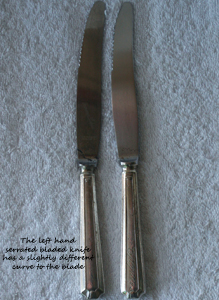
Actually I did notice with this Firth & Brearley marked knife that the angle of the handle to the blade is slightly different when compared to the other five knives, I don't believe it has been damaged, it has just been made that way - here is a photograph of the "Firth" knife sitting alongside one of the other serrated bladed knives ...
B) I have referred to these knives in the title as "Hotel Silver" (not sterling silverware but silver plate intended for commercial use) ... each knife has been clearly engraved (again, this looks to have been done by hand, not a machine) CHEQUERS and in fact to support my conclusion that they have all been hand engraved, I noticed that some of the engraving was not quite placed in the same spot as other knives - the human touch at work!
Now, it was this name engraved on the handles that grabbed my attention and the search began (with mixed results) Just who were these "Chequers"?
Three possibilities were arrived at, and keep in mind I have no definitive proof regarding any of these theories ... we are talking evidence from around 65 years ago and not a lot of people talk about the knives they ate with!
Possibility 1: (most likely in our opinion)
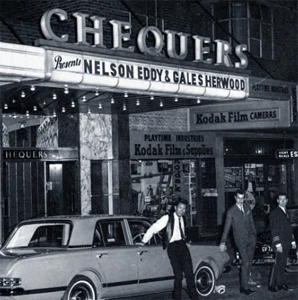
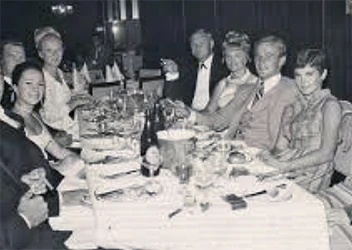
Chequers was an extremely well known, glamorous nightclub and cabaret venue in Central Sydney and in fact it was voted by Variety magazine as one of the top ten nightclubs in the world! Often bringing in big name stars such as Sammy Davis Jr, Liza Minelli, Shirley Bassey to name just a few. It operated in its original form from the late 1950's until the late 1960's but then rebirthed as a live rock venue from the 1970's onwards.
Of significance to me was that this was not only a place of entertainment but apparently they had a large hospitality staff offering a wide range of meals to guests and performers alike. It is said that guests could well end up sitting at a table with the likes of Sammy Davis Jr, chatting over dinner - Wow!
Of course, in such a "classy" establishment you don't offer plastic or moulded wooden flatware! Hard wearing Stainless Steel along with the Silver plated handled knives would have been much more appropriate. We actually think it is quite likely that although these knives are all of the same design/pattern, they come from different sources and time periods as evidenced by the different markings on the blade areas (or the lack of)
Now, no hotel would be in the habit of giving away their utensils so we actually suspect these knives were "slipped into the handbag" and taken home as a momento of the night. These knives were never offered for retail sale and were exclusively supplied to "Chequers"
Possibility 2: (less likely in our opinion, although ...)
Perhaps the knives are of mixed heritage. Grosvenor trade name was also used in England (Sheffield) but in much earlier times, during the 1920's~1930's. This may explain why the three serrated knives differ in markings or the lack of (no GROSVENOR STAINLESS etched on two of them and the third having a reference to the Sheffield maker Firth & Brearley). Perhaps these were from the initial flatware supply to CHEQUERS?
Looking around for other "CHEQUERS" of note, particularly "higher class" hotels, all I found was a reference to Chequers Hotel in Newbury, Berkshire, England. Operating for over 200 years, National Trust Heritage listed and it fits the time scale of these knives (sort of) and is actually still in business but we seriously doubt these knives were used at this establishment because we are pretty sure at least three of them were made here in Australia, why ship them over to UK?
Possibility 3: (remote in our opinion, although you never know ...)
Perhaps, just perhaps there was a "well-to-do" family who used only table flatware with their family name engraved on it? It seems unlikely and Google AI comes up with blanks when asked about a prominent Australian family called Chequers, that's not to say that we have a lot of confidence in Google AI !!! - it often throws us "curved balls" as it is not really very intelligent, just a gigantic library of bits of information which it doesn't quite know how to sort out properly.
We think this third possibility is quite (well, actually VERY) remote ... it just seems so unlikely.
COSMETIC CONDITION:
After 65+ years in use at a commercial environment, or perhaps a household who handles their flatware very roughly!, there are obvious signs of usage over the years ... particularly the serrated edge bladed knives.
I have the distinct feeling that here are two different "time groupings" of knives ... three are in "better" condition and do not appear as "used", all with consistent markings GROSVENOR STAINLESS and the engraving CHEQUERS in Gothic text.
Three of the knives, those with the plain curved blade, weigh 67 grams each
The remaining three knives (with the serrated edges) look more used, the engraving is more worn down and the GROSVENOR STAINLESS engraving is faint and has an M added underneath word STAINLESS - all of these are also engraved CHEQUERS in Gothic text. The third serrated bladed knife does have GROSVENOR but also identifies the pattern as DELPHIC plus has this reference to Firth & Brearley engraved on the blade ... of course the CHEQUERS engraving is on the handle, in the same Gothic text.
These three serrated bladed knives weight 51 grams each! I have no idea why but can only conclude that a lighter base metal was used to produce these - I actually suspect they may not be of Australian origin at all but could in fact have been made in England, by Grosvenor.
In general terms ...
NO bending to any of the blades
NO physical damage (deep cuts, missing decoration etc) to the handles
NO significant scratching to the Stainless Steel blades ... Yes, there are scratches but none that we consider to be in the "OMG" category!
The handles all needed a good cleanup after what appears to be years of neglect (very dark tarnishing to the handles) The knives in need of most attention were the serrated bladed types, I feel these are an earlier release from Grosvenor. These have been cleaned up using non-harmful chemicals such as the good ol' Baking Soda and Aluminium treatment and now all handles look "reasonably good"
What does "reasonably good" mean?
I would rate (out of 10) the three knives with the plain curved blades as 6/10 overall, judging by the obvious usage wear to the handles and condition of the blades.
The serrated knives though would only get a 4/10 from me because the wear to the handles is more obvious and the blades have a couple of Black marks which would not lift off with cleaner at all. I am wondering with these Black marks if the Stainless coating has failed.
"Reasonably good" to me means, Yes they are once again looking like "Oh you bright shiny thing, you" but you can easily see they have been used, A LOT! Quite a few small dings in the handles metalwork, after all this is a top layer of the soft Silver metal which has been electroplated onto Nickel but I could not see signs of Black spotting or breakdown of the Silver plating (where the base metal underneath would show through)
The Silver plating is probably quite "thick" (although not stated on the knives) as these were intended for use in a harsh commercial environment - dings Yes, absolutely but falling apart ... no way!
Actually, the used appearance just adds to the "historical, nostalgic" look!
As always, I have now packed each of these knives into individual sealed clear plastic packets to reduce the tarnishing of the Silver which will occur slowly over time due to interaction with the environment.