


BACKGROUND:
Wow! Dug out this little beauty (if you find well made rotary switches beautiful!)
Constructed in true German fashion, functional and tough as ... although the parent company, ITT was an American company (massive conglomerate with manufacturing facilities worldwide)
Dates from at least 35 years ago, based on the identification stamp in the metalwork indicating made in West Germany, before Unification in 1990 - ITT had a switch manufacturing facility in Freiburg and this was most likely the location of this switches "birth"
Stand out features (from my perspective) are the solid metal 'front end' providing rock solid position locking, the ease at which each switch wafer can be dismantled for initial wiring & general maintenance such as cleaning (this is an open frame switch afterall) and last but not least, the Gold plated switch contact areas.
Enough said as a general introduction ... let's get down to the details
ITT (West Germany)- 11 Position Rotary Switch
Made in West Germany
Here is a photograph of the 'head' topside
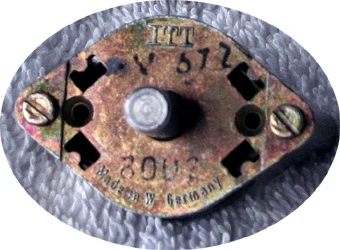
Note that Black stamped numbers V672 & 3002 - I have no idea what these codes indicate, I guess an internal part number code
All body components are metal i.e the 'head' of the switch which looks after locking the switch in each position and rotating the central metal flat shaft which in turn rotates the wipers of each switch across each conducting pad on the wafer stators.
The stators are all made from a phenolic, resin based material with the wiper being on the White plastic or nylon material (it has quite a low melting temperature as my soldering iron discovered!) The common wiper 'ring' is continuous around the switch which means the contacts would be 'break-before-make' in operation.
The contact pads look to be riveted to the phenolic stator and a similar arrangement for the wiper but with a strong spring ensuring good positive contact between the wiper(s) and the contact pads. Peering closely into the switch assembly I can clearly see that Gold plating has been applied and also that the wiper-pad contact surface area is quite large - both of these factors combined would make for great reliability.
I was a little surprised to see Gold being used instead of Silver due to the possibility that if the switch is very frequently rotated, those contact points may wear more because Gold is a soft metal compared to something like Silver. I looked for signs of wear but could see none.
Oh ... perhaps you may be wondering where on earth this switch was used? A beautiful German piece of test equipment used to check long distance communication systems, this switch was used to select various AF filter elements when making measurements at different frequencies.
Electrical Characteristics of the switch: This has a single pole with each wafer having screen printed location numbering, BUT the metal head of the switch only allows for 11 switched positions whereas the wafers have 12 contact sets available.
ALL this means is that this is a 3x wafer switch, each wafer being 1 Pole and 11 Position
Notice that weird wafer right at the end of the switch? It is purely for interconnection, hard wiring of components 'point to point'. It is totally passive in function ... in the original equipment, it had various capacitors hard wired from this wafer up to various switch wafer contacts as part of the frequency changing system.
SOME DIMENSIONS:
Oval shaped front section of the head which mounts onto a panel, measures 39mm across x 25.75mm height
Two mounting threaded holes spaced 30mm apart, the mounting bolts are supplied
Switch control shaft measures 6mm OD x 11mm length
Total switch body length is 82mm front to rear
SOME HELPFUL DISMANTLING-ASSEMBLING NOTES:
There are 8x Nylon or Plastic sleeves (Milky colour) that slide over the two main rear bolts, these act as separators. Those sleeves are NOT all of the same length, 4 being slightly longer than the rest. Don't get these confused otherwise your reassembled switch doesn't go together properly.
The rotor is just a piece of flat metal which mates with slots in each switch wafer - aligning the rotor and the slot can be bit of a pain, some patience is required here.
I looked all over the 'head' of the switch but cannot see any method of changing the number of switch positions, it just seemed curious that the head switches 11 positions but the switch wafers have 12 contact positions ... anyway, I could not see a method to change this.
No rating information regarding the MTBF or contact voltage and current but I wouldn't be using this to switch above 30V DC and only at low currents.
Definitely not suited for 240V operation!!!
COSMETIC CONDITION:
USED
Clean - particularly the switch contact areas, these have all had a 'squirt' of contact cleaner & lubricant. Tested measured various contact points and the DC resistance is extremely low, actually WELL below what my current measurement equipment can measure reliably.
Prior to disassembling the switch, I did try to desolder with the iron but it was not an easy job when assembled! A couple of slips occurred where there was LIGHT melting to a couple of those separation sleeves - nothing dramatic but you can see where Russ 'lost control"!
After my brain kicking into action and telling me to take the 'sensible approach' by dismantling the switch entirely, I have desoldered (solder sucking machine "The Big Suck" sitting in the corner) each contact solder tag so that the eyelet is free of solder - all contacts are now ready to go!
Note that a couple of the solder tags look bent but in fact that is how it was manufactured, so that those solder tags clear the main bolt(s).
Phew, a lengthy description of this switch but I just love this sort of mechanical switch - they don't make them like this one any more!


