

BACKGROUND:
More "unloved" chinaware handed to me by my wife ... actually that isn't strictly true as we both adore the age of Art Deco but alas there was an incident and the teacup is no more. My wife is scrambling to find space for her new acquisitions so chinaware like this must leave the house ...
Melba was the tradename used by Mayer & Sherratt, not really a long time player in the world of English china as they only operated between 1906 ~ 1941 (in essence, WWII put an end to their business) but they were very well known for their very artistic, particularly Art Deco style, chinaware's. My wife has one of their "flower handled" teacups, absolutely gorgeous!
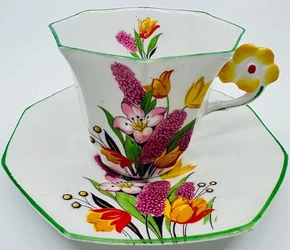
The design used on these three pieces is a perfect example of a quite simplistic Art Deco style with irregular edges (especially the cake serving plate), Black painted finish to the rims and of course the bold colours used for the flower decorations.
DLAT Rating: 9.0/10 (Darling Look At This!)
MAYER & SHERRATT - Saucer, Side Plate & Cake Serving Plate ONLY
Made in England
All pieces can be purchased individually OR give all three a new, caring home (if all three remain available) and an automatic discount comes into play at the checkout
Fine Bright White Bone China base
Tradename: Melba
Design/pattern: Art Deco styling but there is no indication of the pattern code or name
Circa 1930's ~ 1940's period
Translucent fine china, meaning that when it is held to the light you can easily see the shadow of your hand through the chinaware
Hand painted
Very typical of the period Art Deco styling, irregular shapes (especially the cake serving plate), strong bold colours applied geometrically.
Not a whiff of Gold on these!
BACKSTAMP DETAILS:
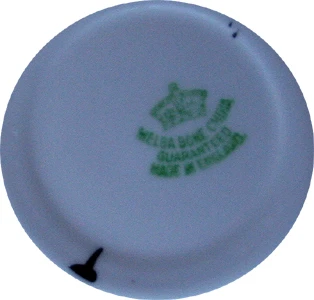
Artist's "mark" appears to be the Black paint on the underside, although it is not much of a mark!
DIMENSIONS:
SAUCER:
139mm diameter
SIDE PLATE:
Square shape with rounded corners (broadly scalloped) 154mm x 155mm
CAKE SERVING PLATE:
Broadly shaped as a square plate but with rounded "tab handles" on two sides, making for a plate that has two straight sides and two curved sides, the curved sides have broad scalloping.
Square depression in the central area
253mm (rounded sides distance) x 215mm (across the straight sides)
COSMETIC CONDITION:
This first part of the condition report is common to all pieces, followed by specific comments relevant to each piece
Very Good condition (for almost 100 years old!)
NO cracks
NO crazing (this stunned me, after all this time I would have expected some crazing but I have checked both dry and wet, there appears to be none so far)
SPECIFIC PIECES ...
SAUCER
A light scratch on the Mauve coloured flower bud, all other colours are solid and unmarked
Black scalloped edge finishing is in very good condition with only the very slightest signs of handling
One fleabite underneath, this is not discoloured
SIDE PLATE
No scratches on the flower buds or elsewhere on the decorations.
Similar to the saucer in that the Black scalloped edge of the plate has only the slightest signs of handling
One fleabite underneath, this is also not discoloured.
I did notice a couple of "pin holes" topside, it looks as though the glazing process did not complete properly and left these tiny "holes" in the glaze.
CAKE SERVING PLATE
The Yellow flower bud and both Orange buds have little discrepancies such as what appears to be another colour got onto the brush, like a Brown, and slightly altered the colouring. One of the Orange bud outlines looks quite jagged but it has not been scrapped off or user damaged, it just appears to be improperly finished.
A couple of the same "pin holes" topside which look to be as a result of imperfect glazing when fired.
No fleabites observed at all but one small Black dot which feels raised from the surface, as though the base china had some dirt in it!
For most, these little "flaws" have no signficance, but for others ... well, some seem to expect perfection in a human crafted piece and after 100 years of life on this earth ... pretty high expectations in our view.
We often wonder "What was it like for the pottery workers who were producing these, especially at the beginning of World War II - were they slaving away at the works while the V2's were flying overhead? Scary! Certainly enough to cause the worker to have a "slip of the hand" or a bit of dirt in their clay!
Holding this type of chinaware is like taking a step way back in time, who was the lady (most likely) who worked on this piece, what was her life like back in those days? Alone, her spouse was probably off fighting the Hun or had already been captured or killed.