

BACKGROUND:
You may be thinking "Russ is at it again ...WTF?" about this item ... to many these may just be a bunch of used LED's destined for landfill, but I don't view old components that way because I am "really big" on reusing or repurposing old electronic components and hardware, particularly from the point of view of sustainability and I know others think likewise.
I implore you ... if you see some old "useless" piece of equipment, try to view it as a "component farm" and visualise what treasures it may hold (and sometimes little gems can be found) and these components could be cultivated for reuse.
Sustainability far more than NOT burying waste material back into the earth but consciously recognising the energy expended to create the item through it's various "stages" in life, beginning with the raw materials being extracted from the earth, processed, finished and then fitted into equipment - every single step used energy which is referred to as embodied energy.
To give an approximate representation of how much energy was used in the WHOLE production process of an item, I have created what I refer to as the Ee (Embodied Energy) value, measured in Mj
The Ee value is an approximation only and usually measured in Mj.
Coming up with an Ee value is an attempt to take into account the energy used for extracting and processing of the raw materials, manufacturing of the component, distribution of the component(s) and final assembly of the component. In fact the measurement of Ee can become extremely complicated and technical, many tertiary institutions are involved in this specialised field of science.
I have used various reliable sources online to arrive at approximate Ee values, these are approximations and the sole purpose is to raise awareness of the extraordinary energy consumed in the creation of various electronic components and hardware - it may give you cause to think twice before wasting all that energy and burying it in the ground, with the possible side-effects of poisoning the environment due to leeching.
HERE is a page I have created which gives some tables and more detailed information about specific Ee values for different materials plus a link which you can use as a starting point to investigate Ee for yourself.
This component has been removed from professional broadcast industry equipment originally manufactured here in Australia although that really doesn't help with the question "who manufactured this component?" - I cannot find any markings on the body indicating this.
UNIDENTIFIED MANUFACTURER - RED LED Indicator Lamp
LED indicator technology (not incandescent)
Colour: RED
Diffused lens
All metal body, locking clip and nut. The LED is inserted from the rear although I could not make it come out (a possibility was changing the LED colour but I couldn't remove the old LED)
The rear of the lamp has a small RED dot next to one post, the Anode (positive)
I call these posts as they are not just straight wires coming out of the rear but have a "fatter section" at the end so that wire nicely wraps around the post and stays there when being soldered.
NO series limiting resistor! These should be operated at around 1.8V ~ 2.2V @ 20mA - go higher and you will quickly "cook" them.
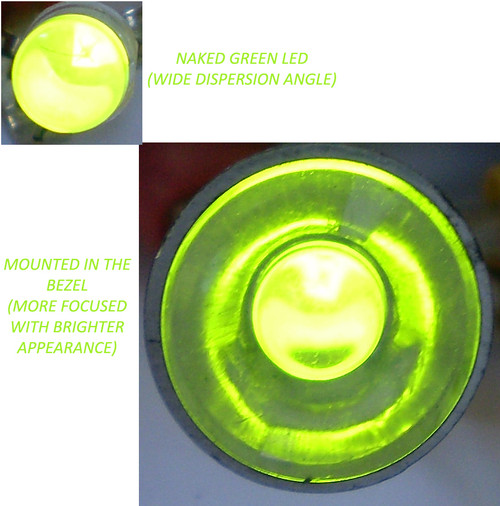
Light emitted by the RED LED is of medium intensity, not too bright nor too dull - just right for front panel applications viewed in both daylight (easily visible) or subdued lighting.
DIMENSIONS:
17.6mm length (front to rear, excluding the solder posts)
The solder posts are a further 6mm long
Diameter hole (circular) for fitting: 6mm
Diameter of the front flange 7mm outside diameter
COSMETIC CONDITION:
USED
Clean
NO metal body damage
NO Black insert damage
Solder posts are clean and ready for action once again
Each LED comes with a locking split ring and metal nut for mounting
TESTING:
Using a forward current of 20mA, I checked every single LED for intensity and of course, normal operation - no problems with any of these at all