

BACKGROUND:
I have been in the electronics game for many, many years and over the last couple of years I have slowly been finding "new workshops" for a lot of bits & pieces that I have gathered over time due to my previous business activities and on a personal hobbyist level.
Opened up a box today and Oh My! I found this "golden oldie" still sealed in the plastic packet, I couldn't believe my eyes ...
This is a complete CRT rear plug assembly for use with old (actually very old) monochrome CRT's, complete with the insulating rear socket protective cap and the flying leads which connect to the main board. I would place this socket assembly from the 1950's ~ 1960's era, based on the socket which is definitely bakelite (a very early plastic, which tested "bakelite positive" to the "rub" test and that distinctive smell of formaldehyde) and the fact it is an 8 pin socket, not the usual 10 or 12 pin sockets found on later colour CRT's
Even more astounding was the condition, if only I looked so good after 70+ years!
Enough chat ... here are the details of this assembly
UNKNOWN MANUFACTURER- OCTAL CRT SOCKET with flying leads (within an insulating tube)
Country of origin is unknown and not indicated on the socket
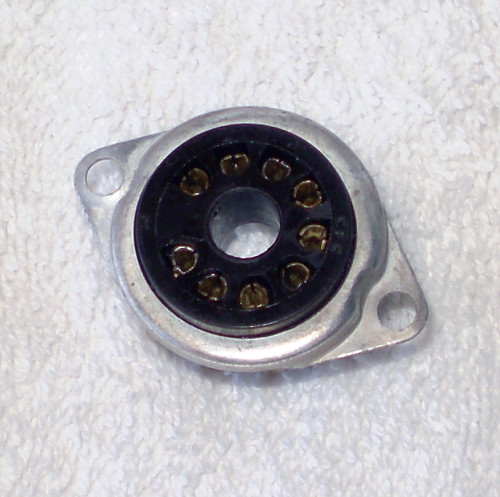
The only marking, besides the pin numbers, is a C impressed into the bakelite, inside the socket - nothing else. This could be the socket type or reference to the manufacturer, I have no idea which it may be though.
8 pin female socket with locating notch at the pin 8 ~ pin 1 junction.
Standard solder tags to the rear, to which 6 colour coded wires are attached (of varying lengths) - these wires run inside a flexible insulating tube except the Yellow wire.
Hey, hang on a minute (I hear you ...) Octal socket but only 6 wires?
The connections are:
Pin 1 = Black
Pin 2 = Green
Pin 3 = Orange
Pin 4 = Blue
Pin 5 = NO CONNECTION
Pin 6 = NO CONNECTION
Pin 7 = Yellow
Pin 8 = Brown
These pin numbers are as read from the underside of the socket, each pin marking is stamped into the bakelite.
I cannot recall which colour wire was intended for each element of the CRT, in any case these were the days when there wasn't really any established standard and the wiring could well vary between tube manufacturers. If ever someone was actually going to put this lead to work, they would need to find out if the current wiring will suit their own CRT.
Fitted over the rear of this socket is a milky White coloured plastic insulating cover, this has a slot down one side to enable removal or attachment of the cover, it just friction fits over the base of the socket.
Each wire is stranded and at the "far end" has been factory "pre-soldered", ready for attachment to the main board(s).
COSMETIC CONDITION:
NEW Old (very) Stock
CLEAN
Remarkable condition quite frankly, if it wasn't for the bakelite and the fact it is an octal socket for CRT's, I wouldn't have believed this came from the 1950's ~ 1960's era - actually it is probably more like the 60's era due to the hybrid of the bakelite socket with "modern" plastics being used for the back cover, wiring insulation and wiring sleeve.
This socket assembly has been returned to a sealed clear plastic packet and now patiently awaits a new owner (of a museum most likely!)