

HISTORY
A large percentage of the Silver plate that we have been provided with by extended family fall into the late and post WWII period 1940's ~ 1990's but this toast rack would appear to be from a much earlier period, probably around the late 1800's ~ early 1900's.
John Gilbert were Silversmiths and platers who do have an entry in the Sheffield Assay Office, with the entry being dated 1812 (page 14 of the SAO reference) but the company identifying marks appear to have changed over time and are complicated by their use of fake hallmarks which were designed to confuse the prospective buyer into thinking the item was Sterling Silver. This practice by Silversmiths and platers was widespread and later banned around the 1970's.
Unlike much of John Gilbert silver wares, this toast rack is not ornately decorated at all, quite plain in fact - I have the impression that this toast rack is from around the 1900's and is perhaps an example of "economy model" John Gilbert Silverplate toast racks, I have seen others from earlier in the 1800's which are much more ornate (with asking prices to match!)
I do believe that this is Sheffield plate, using the electroplating process, not Old Sheffield plate which used the fusion of silver sheets and a copper substrate, unfortunately I am unable to identify the base metal used for this toast rack (comment: it is surprisingly heavy for it's size)
Let's get down to some details ...
JOHN GILBERT (Birmingham UK) Silversmiths - Table Toast Rack
Made in Birmingham, England
Circa late 19th ~ early 20th Century
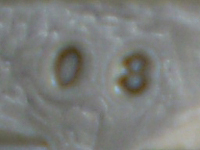
Identification has been made using the stamped impression on the TOP side of the toast rack. I also have found a curious stamp on the underside, this reads simply 03 and I could not find any references to John Gilbert's using numerals like this - possible an item model number or even perhaps the year of manufacture (1903) - I am just guessing here without any definitive information about the purpose of these numbers.
Here is a closeup photograph of the topside Silversmith's mark and the EP indicating it is plated
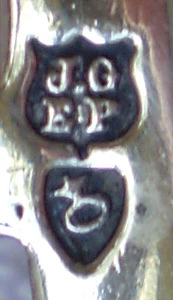
Note the absence of the letters NS next to EP on the 2nd line, supporting the view that the base metal is not Nickel, most likely a Brass base metal.
The symbol below EP appears to be the fake hallmark.
Here is a closeup photograph of the numerals stamped into the underside
Silverplate (Electroplated) Grade is unknown as it is not indicated and I cannot see signs of "Silver rolling" which was used with Old Sheffield techniques of plating.
All metal joints have been Silver soldered, no part can be removed or unscrewed, including the centre carry handle
SOME DIMENSIONS:
OVERALL:
Table space: 2.25" wide x 4" long
Toast holders (4) are 3" high x .5~.75" wide each. The width varies as the top of the holder is narrower than the base, to hold the toast in place securely.
NOTE: each slice holder is quite wide, remember that back over 120 years ago you were not using "pre-sliced" bread but a loaf which was sliced at home, usually the thickness of toast was much more than "modern breads" with the exception of "toast slice" commercial bread.
Carrying Weight: 180g
COSMETIC CONDITION:
As mentioned above, when I was handed this piece of "old" Silver plate, I wasn't expecting anything too exciting but this toast rack really surprised me.
Yes, I have cleaned it up a little so that I could read and photograph the "maker's marks" but the Silver finish is in VERY good condition.
CLEAN
Barely any scratches of significance ANYWHERE on the toast rack and no man-made marks.
I noticed while giving the rack a good cleanup that there were just a couple of tiny "black spots" (oxidisation dots, due to the Silver reacting with the air) on the base strips but surprising little after all this time ... it is possible that these Black dots (there are only a few) could be polished away, I have not attempted this as it is a tricky place to get a finger into!
I had the impression that the plating is of a good thickness and the rack has obviously been looked after over the last 120+ years!
High lustre (this toast rack is "dressed to impress!")
Where the top holder arches meet the base, it has been Silver soldered. I observed that although still very nice plating in this area, a slight dullness around the joins can be seen.
Very important for a toast rack! It stands nice and stable, "true" on a table - it does not wobble! No part of any metal work is bent or "out of shape" - in fact it would take quite some effort to bend this out of shape as the metal is a very solid feeling .2" wide x .1" thick metal on those toast holders and the base metal strips are .3" wide x .13" thick - this is one tough little toast rack!
There is no decorative work at all, plain Silver plated metal.
I am always in awe at the idea I am holding something in my hand which has obviously been skilfully crafted over 120 years ago ... a feeling I do not get when handling something from K-Mart! or even David Jones. Someone recently told me that "I can get one of those down at K-Mart for $5!" Seriously? I really do not think K-Mart stock 120 year old Silver plated toast racks! Takes all kinds to make up the world!
Now that I have carefully examined and described this rack, it has been placed into a sealed clear plastic packaging to try and reduce the gradual oxidisation of the Silver top surface - it's a natural thing that anyone who handles Silver will know about.