

Wedgwood (Josiah) pottery, porcelain and ceramics are of course extremely well known. This is a company that has been "around" for a very long time, since 1759 when Josiah was just 29 years old.
My wife has taken to collecting very early English porcelain and chinawares, pre-1900's, but decided that this quite large sweets dish wasn't quite what she was looking for, her interest being more in the vases and figurines line. She used it a couple of times for setting in the centre of the dining table, offering cold sweets such as candy's. Actually the dish is quite an unusual design with just a single tab handle, not the more common double tabs, so any "goodies" inside the dish need to be fairly light in order to lift and offer the dish safely.
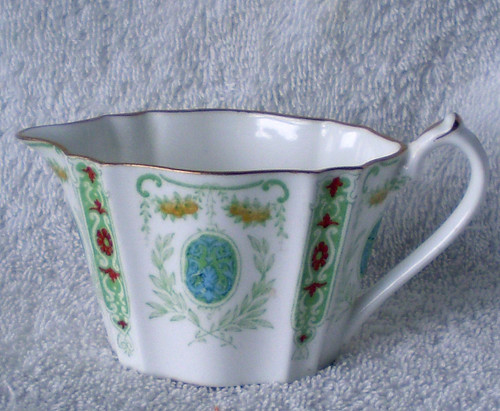
This piece is Wedgwood, but, like the small jug she also handed to me, a couple of little details "niggle" at me about this dish ...
The backstamp is stamped, not impressed and although the backstamp layout ticks all the boxes for the period 1891 ~ 1910, I could not find out the meaning of the 3 stars just underneath the urn nor the single star underneath WEDGWOOD
I was expecting some sort of date coding as well but there is just a hand applied code to the far lower side of the main backstamp but for the life of me I could not see that as being a dating code (it does not seem to agree with any of the codes Wedgwood used during this period) - it is more like a pattern code.
Please inspect the photograph I have taken of the backstamp to get a good idea of what I am talking about.
WEDGWOOD (Josiah) - Sweets Serving Dish
Made in England
Circa 1891 ~ 1910
White translucent bone china
I checked on the bone china aspect (as opposed to the possibility of being porcelain) and am positive this is bone china and not porcelain. When held up to a bright light, it is "mildly" translucent (being very thick walled) and has a sort of milky White appearance. Due to the overall "heavy build" of the dish, the weight is also on the heavier side for a dish this size, and it does not have that "egg shell" feel that I had when handling the small jug from the same era.
Shape: Circular with a side tab extension on one side only ... this gives the appearance of an oval dish but in fact it is a circle.
Horizontal fluted sides which run into the centre of the dish
Broad scalloping around the top rim
Design: Unknown (not indicated on the backstamp)
Hand decorated - I have examined this dish very closely and there is no doubt this has been hand decorated and gilded.
The decoration consists of branch sprigs with a dual set of Pink and Blue flowers and some sprigs also have what appear to be Yellow buds.
The central area of the dish also has a similar artwork.
Inter-linking this decorative work is the use of extensive Gold gilding and a heavily applied gilding around the top rim and tab handle.
There is no decorative work on the underside at all.
DIMENSIONS:
230mm (9") diameter with one side having a 21mm extension as part of the lifting tab handle
The inner diameter (centre) of the dish is 152mm (6") diameter
Height is 45mm
This all means that you are looking at a quite large dish, with gently outwards sloping sides. My wife has always assumed it was for delicate pieces such as cold sweets, especially smaller candy's which will not cover that central artwork and she suggested that I tell any prospective owner NEVER to put hot food for serving into the dish, it just doesn't look suitable for that purpose.
Of course it goes without saying, NEVER EVER machine wash such a dish nor use it in a Microwave!
Weight: 500g
BACKSTAMP:
Here is a photograph of the backstamp underneath. The main backstamp is a light Brown or Tan colouring and the hand written coding is an Orange

COSMETIC CONDITION:
USED
NO cracks
NO chips
NO crazing at all! I am stunned but after wet & dry testing I cannot see any signs of crazing
NO discolouration to the artwork nor the base White china
Almost no wear is apparent to the artwork, with the exception of one of the flower "sprigs" where I could see a light scratch across the artwork ... see one of the photographs.
The Gold gilding is in very good condition with no apparent handling wear but I can see (when held in the sunlight a certain way) something like very light scuff marks or scratches to the Gold surface. These scratches are very subdued and need to be looked for i.e they are not obvious.
In the central blank White china area I can see a couple of light "knife cut" marks but again, nothing very significant.
NO fleabites on the underside
Another "almost" perfect example of early Wedgwood although this cannot be called OLD Wedgwood as we would be talking about a piece from the 18th Century! The company has a VERY LONG esteemed history!