

EQUIPMENT BACKGROUND
Oh the venerable cathode ray tube! Such a vital component many, many years ago in both industrial and consumer electronics but it's days have long past (unless you are an avid old Skool gamer or arcade machine restorer) I remember back in the 1980's working as a Technical Sales Rep for Mitsubishi Electric and getting these "spec'd" into various industrial projects ranging from elevator lift monitors (little 9" Green or Amber screens) to the big hi scan rate monsters used at power plants, airports and pretty well anywhere process control system monitoring was required. Technology has rendered much of these CRT based displays obsolete but the basic principles behind how they work are still taught at educational institutions and the good old CRT has a special "air" about it!
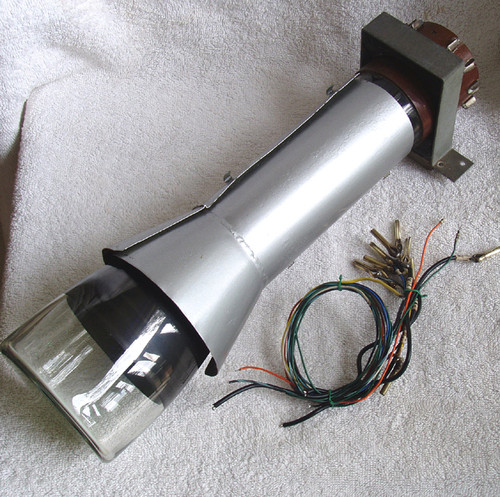
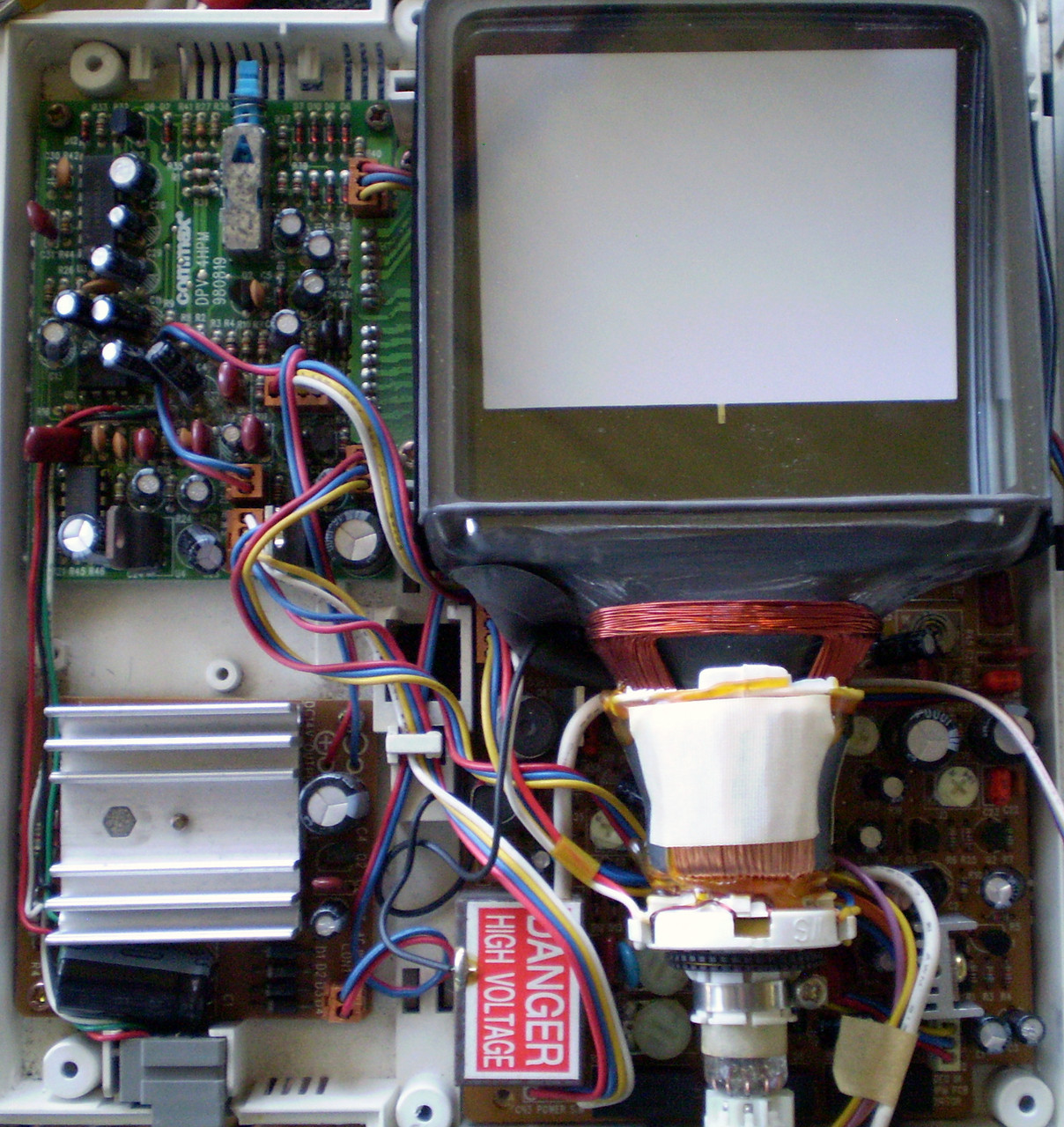
This CRT is different, not because it is very small but because it SIDE WAYS projects the electron beam onto the phospor, sort of like a traditional CRT which has been flattened.
So what, I hear you asking ...
The advantage of this construction is that you can see right inside the gun from the top/front and also the active phosphor layer that the electron beam strikes - nice (if that sort of thing excites you or you are demonstrating how a CRT works to others)
With a standard front facing CRT, you cannot look inside at the gun nor the phosphor, which is INSIDE the front screen.
The equipment this CRT was extracted from (carefully) was an old 1990's COMMAX DPV-4HPD Video Doorbell system which was no longer functioning (low voltage PSU supply failure). Just as an aside, it's interesting that the product used a "modern" CCD camera, modern analog componentry (although on a side sided through hole board) and yet, the display is based on dated CRT technology - there must have been a cost factor to take into account, LCD displays were not cheap in those days and possibly too slow as well.
That's the broad background in a nutshell ... here are more specific details
CATHODE RAY TUBE (CRT)
Commax was a Korean manufacturer and I suspect the CRT is also of Korean manufacture although it could also have been Japanese.
The markings on the neck didn't help me identify who made this, those markings are:
WOOSIN - AAE
SJA-A009
E 167835
The obvious one, WOOSIN, drew blanks so the maker is at this point unknown
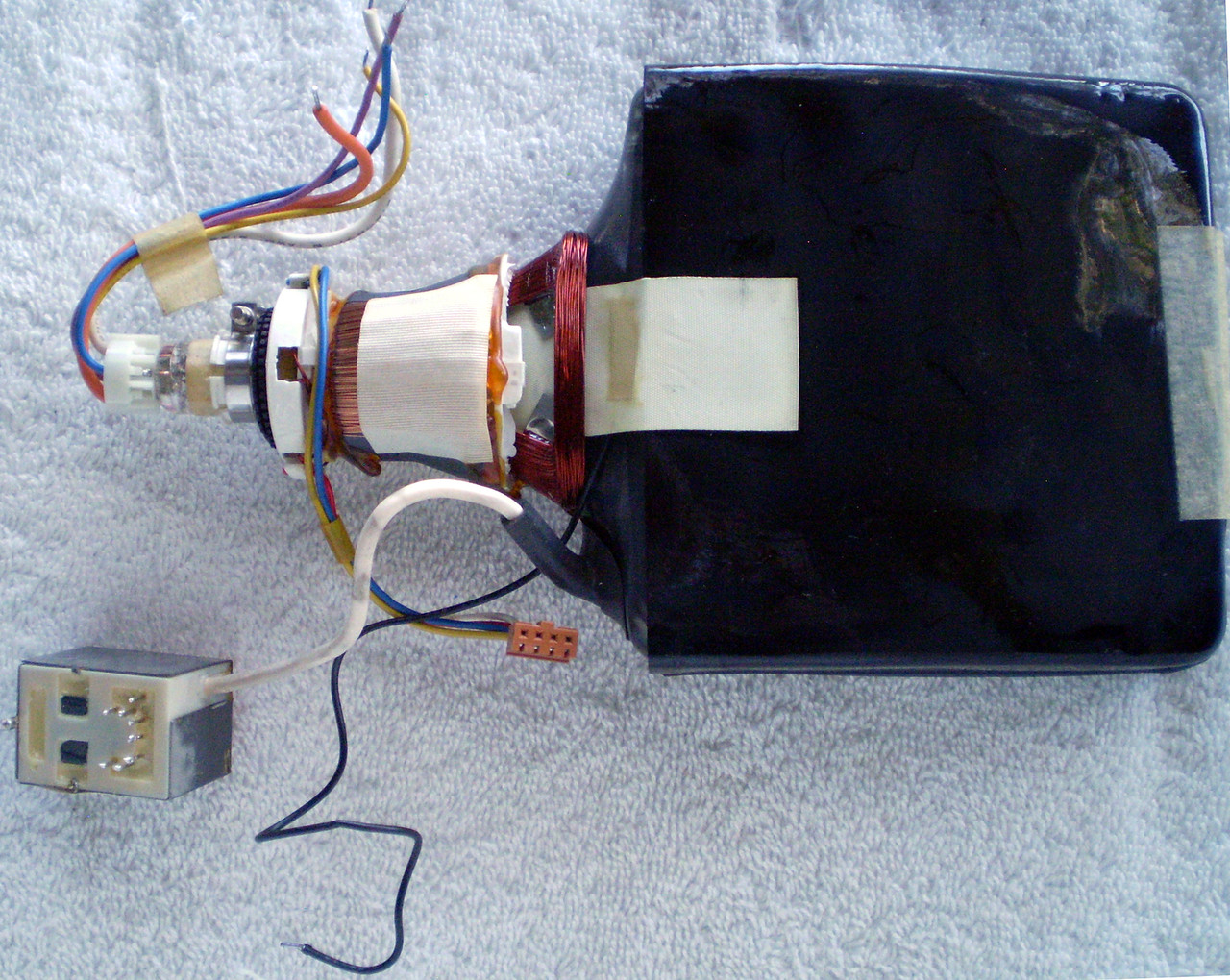
Supplied with the 8 pin connector on the neck, the Anode cap with lead which is permanently connected to the SFT 9202A by D.H Elecric flyback transformer, which has been desoldered from the PCB.
I haven't sat down to work out which wires are connected to which element of the tube except definitely the Blue & Purple are the heater wires (presumably around 5 ~ 6V)
I have included these extra components just in case someone wishes to bring the CRT back to life someday.
An interesting (but most likely impractical) idea is to create an external "electron gun" which could be "fired" at the phosphor screen although this would be difficult to achieve in practice due to the high voltages needed to get the electrons moving along and then creating a "beam" to fire at the phosphor coating - I even saw someone suggesting using Strontium 90 (a byproduct of nuclear fission) as the source! Not something that most homes or workshops would have "lying around" - sometimes online information is just so stupid!
DIMENSIONS:
Front display (thick clear glass) is 102mm x 102mm (4" x 4")
Actual phosphor display area that is hit by the electron beam is 78mm x 55mm
This coating is a concave, converging meniscus shape like a saucer.
The Anode connection (clip cap style) is near the gun
The glass gun is 90mm length
The total length of the CRT is 205mm including the socket
There is no built-in mounting system for the CRT, it originally rested in a cradle and was held in place by the "sandwich" design of the case.
If, by chance, someone wished to fire this CRT up, always take safety precautions especially around the anode which is typically 2kV or so potential.
Even if not powered up, handle with extreme care because these strong glass tubes have a complete vacuum inside. If the glass becomes cracked, you can end up with a nasty implosion - watch around the neck area especially.
WEIGHT: 390g
The CRT has now been "put to bed" within copious amounts of bubblewrap and a strong outer cardboard packaging to ensure it does not get damaged when shipped. Have fun ...